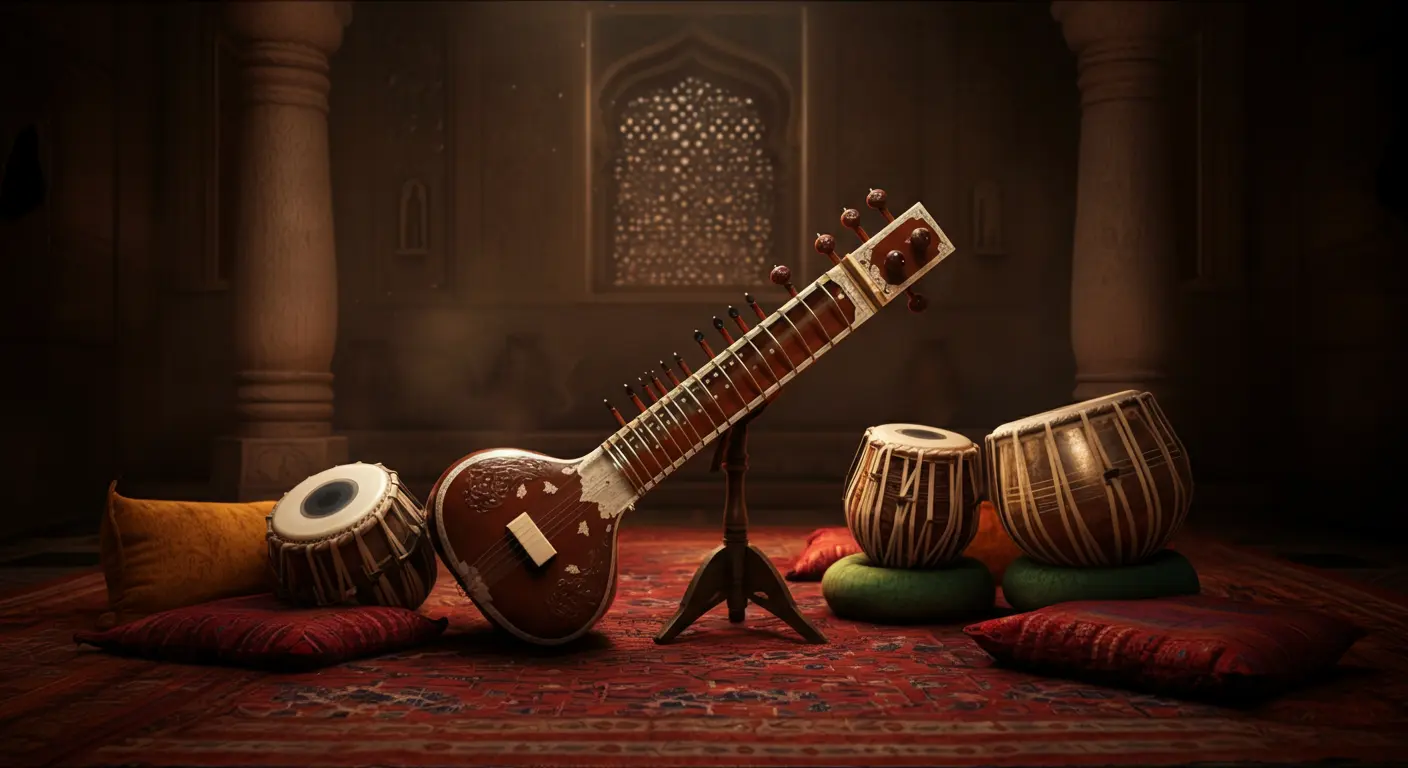
Namaste, fellow composer! ♪ The board awaits like an unstrung sitar, each square a note longing for its place in our coming raga; let us begin softly, layer by layer, until a crescendo of pieces sings between us. Shall we tune the opening together?
Arjun Sitar is a 52-year-old sitar player from India whose chess understanding rivals the deepest engine analysis, reflected in an estimated rating of 3270. Decades spent shaping ragas appear to have sharpened a parallel discipline at the board, where Arjun calculates long forcing sequences with the same precision a maestro reserves for ornamenting a phrase. The repertoire leans slightly toward offbeat practical weapons rather than strict mainline theory, though the foundations remain classical: with White, Arjun frequently steers games into the Italian Game, favoring rich middlegames over early simplification. Black games tend to invite sharper play, often through the Petrov Defense or, against 1.d4, the Queen's Gambit Accepted. Visitors stepping up to this board should expect a relentless, complicating opponent who keeps tension on the position, punishes inaccuracy with surgical tactics, and rarely lets advantages slip back toward equality.
How Arjun plays
Arjun plays with a markedly aggressive, complicating style, keeping pieces on the board and tension unresolved rather than trading down. The choice of lines runs slightly to the offbeat side of mainline theory, though core systems like the Italian Game and the Petrov Defense remain in regular rotation. Solidity sits near neutral, with a faint preference for sharper continuations once the middlegame opens up.
Who should play Arjun
Arjun suits ambitious players from roughly 1800 upward who want a stress test against engine-grade resistance, and is essentially unbeatable for casual club opposition. Anyone who reflexively trades pieces to defuse pressure will gain the most, because Arjun refuses to simplify and forces the opponent to navigate dense, complicated middlegames. Coaches and titled players also use this profile to probe their own preparation under maximum practical resistance.