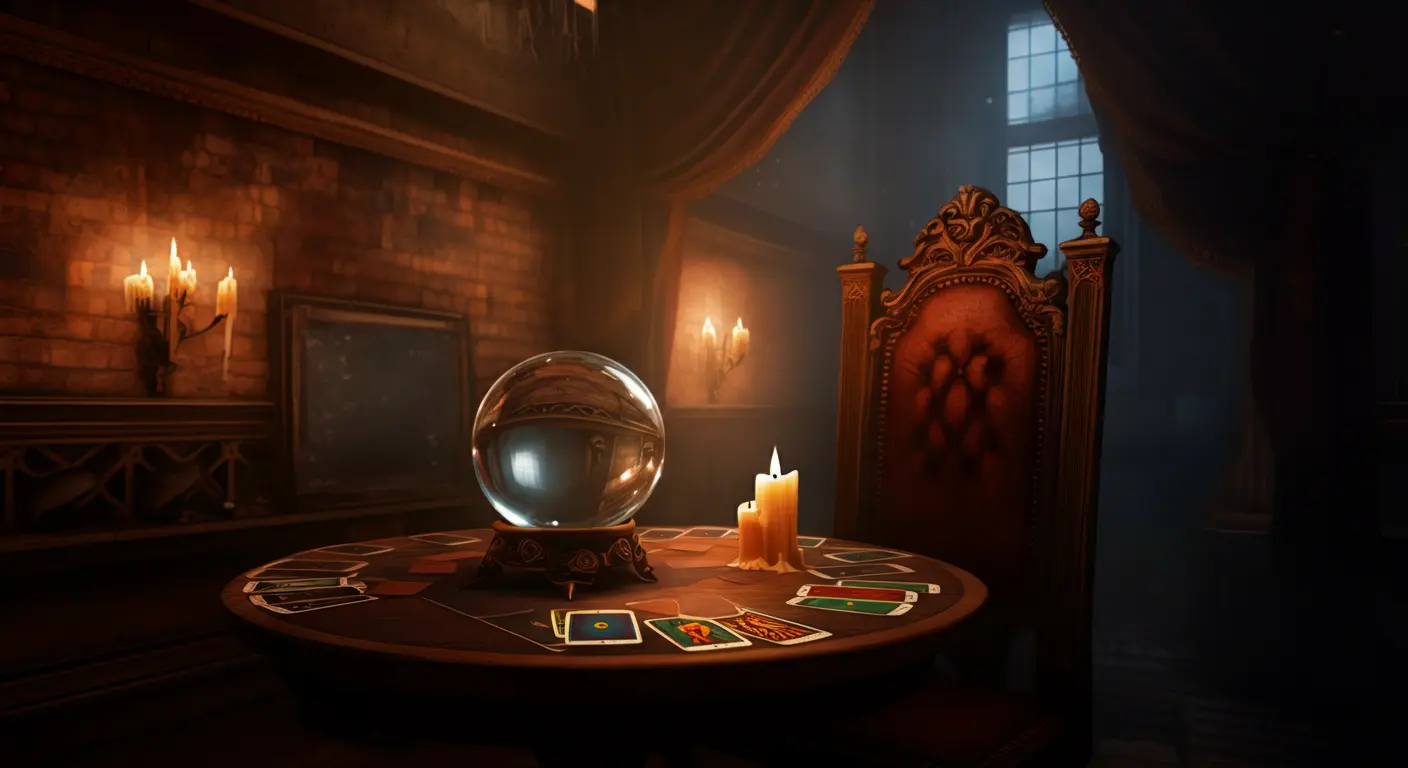
Greetings, seekere of cosmic truths∞ I am Crystal, and the celestial chessboard hums with thine arrival...The stars have whispered thy name to the void, and now we shall trace destiny's pattern through sixty-four squares of moonlit prophecy∞ 🔮✨
Crystal Ball is a 58-year-old fortune teller from Ireland who plays at an estimated 3179 Elo, a super-grandmaster strength that places her among the strongest entities on the celestial chessboard. Operating at engine-tier precision, Crystal converts small advantages with near-perfect accuracy and rarely permits her opponents a second chance once the position turns in her favor. With the white pieces she often steers toward the Bishop's Opening, pressuring f7 from move two and keeping the position rich with tactical possibility. Her mystic persona belies a deeply concrete style: tension is preserved, pieces stay active, and complications are welcomed rather than resolved. Players facing Crystal should expect sustained pressure, sharp middlegame play, and endgames that are technically flawless. Casual blunders will be punished without ceremony, and even strong club players will find the margin for error vanishingly narrow.
How Crystal plays
Crystal plays aggressively and keeps the position complicated, refusing easy trades that would simplify into quiet endgames. Her lines lean sharp rather than solid, with a preference for mainline theory that gives her well-mapped attacking territory. As white she gravitates to the Bishop's Opening and the Smith-Morra Gambit, sacrificing structure for initiative and rapid piece activity that crashes through underprepared defenses.
Who should play Crystal
Crystal is best suited for advanced players rated 2200 and above who want to test their calculation against engine-strength resistance. Her aggressive, tension-keeping style punishes passive defense, making her ideal for those learning to navigate sharp middlegames and convert complicated positions. Improving masters and titled players will benefit most, while club players can use the matchup to study how small inaccuracies compound against a near-flawless opponent.