Sicilian Defense: Classical Variation

-14%
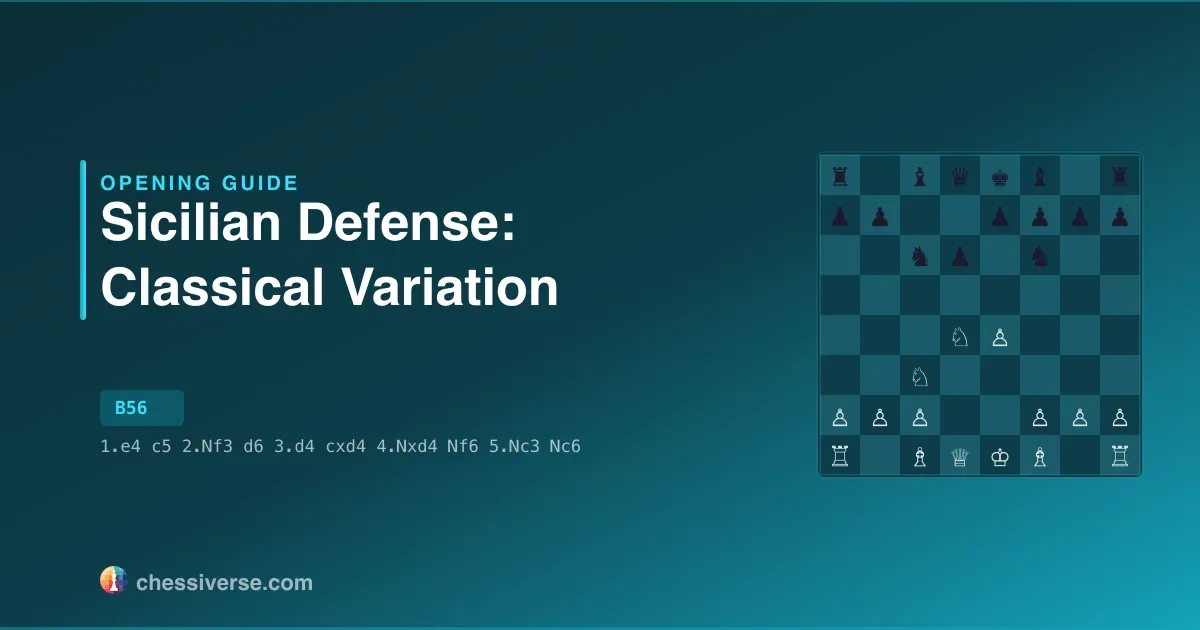
B561.e4 c5 2.Nf3 d6 3.d4 cxd4 4.Nxd4 Nf6 5.Nc3 Nc6
Oct 9, 2026
Play this opening as...
TL;DR

The Classical Sicilian answers 5.Nc3 with 5...Nc6 and keeps ...e6, ...e5 and ...g6 in reserve. White's main tries take some of that choice away: 6.Bg5 (Richter-Rauzer) makes ...g6 and ...e5 awkward, and 6.Bc4 (Sozin) aims the bishop at f7. Across 5.7 million Lichess games, White scores 47.7% and Black 47.3%.

Brought to you by

IM John Bartholomew
IM John BartholomewCo-Founder & Chess Educator

International Master and chess educator. Co-founded Chessable and joined Chessiverse as co-founder. Best known for his "Climbing the Rating Ladder" YouTube series and structured opening courses.

Sicilian Defense: Classical Variation: A Complete Guide
Sicilian Defense: Classical Variation - Opening Moves
Summary

The Sicilian Defense: Classical Variation arises after 1.e4 c5 2.Nf3 d6 3.d4 cxd4 4.Nxd4 Nf6 5.Nc3 Nc6 and falls under ECO code B56. The same position comes from the 2...Nc6 move order, 2...Nc6 3.d4 cxd4 4.Nxd4 Nf6 5.Nc3 d6. Black brings out the last knight and puts off the real decision, which is the pawn structure. ...e6 leads to Scheveningen-type positions, ...e5 to the Boleslavsky structure with a hole on d5, and ...g6 to a Dragon. In the meantime the pawn on d6 stops e4-e5 from chasing the f6 knight, and the c8 bishop already has an open diagonal. Most of White's sixth moves try to take one of those structures off the table, and 6.Bg5, the Richter-Rauzer, does it most directly. With 5.7 million Lichess games across all rating levels, it is a well-established opening choice.

History and Notable Players

It arises from the Sicilian Defense: Modern Variations, Main Line, where 5...Nc6 is one of Black's four main replies, next to the Najdorf (5...a6), the Dragon (5...g6) and the Scheveningen (5...e6). Several of White's answers have names of their own. The Richter-Rauzer comes from Kurt Richter, who played 6.Bg5 in the 1930s, and Vsevolod Rauzer, who paired it with Qd2 and queenside castling. The Sozin Attack, 6.Bc4, is named after Veniamin Sozin, and the bishop move was a favourite of Bobby Fischer's against the Sicilian. 6.Be2 e5 is the Boleslavsky Variation, after Isaac Boleslavsky. Among the most active players in ECO B56 games are Viswanathan Anand (242 games), Vlastimil Jansa (238 games) and Oleg Korneev (231 games) with White, and Lubomir Ftacnik (297 games), Loek Van Wely (271 games) and Boris Gelfand (260 games) with Black.

Statistics

Based on 5.7 million Lichess games across all rating levels:

  • White wins: 47.7%
  • Black wins: 47.3%
  • Draws: 5%

Neither side has a real edge at any level. Black is marginally ahead in the 400 and 1000 brackets, White leads by 0.1 to 1.2 points from 1200 to 2000, Black is in front again at 2200 (47.1% to 46.1%), and at 2500 and above White leads 45.9% to 45.2%. Draws climb from 3.7% at 1000 to 8.9% at 2500 and above. The line gets much more common as ratings rise: it shows up in 0.03% of games at 1200 and 0.79% at 2500 and above. Of bullet, blitz and rapid, bullet is the only speed where Black scores better, 48.5% to 48.1%. Its share of Lichess games peaked in 2020 at 0.15% and has dropped every year since, to 0.09% in 2025.

Main Lines and Variations

After 1.e4 c5 2.Nf3 d6 3.d4 cxd4 4.Nxd4 Nf6 5.Nc3 Nc6, the main continuations include:

  • 6.Bg5: the Sicilian Defense: Richter-Rauzer Variation. The bishop hits the f6 knight, so 6...g6 can be met by 7.Bxf6 exf6, doubling Black's f-pawns, and 6...e5 fails to 7.Bxf6. The main line is 6...e6 7.Qd2. White castles queenside, and Black chooses between 7...a6 and 7...Be7 8.O-O-O O-O. 6...Bd7 7.Qd2 is the Modern Variation.
  • 6.Bc4: the Sicilian Defense: Classical Variation, Sozin Attack. The bishop points at f7, and Black usually shuts the diagonal with 6...e6. White then has 7.Bb3 or the Velimirović Attack, 7.Be3 Be7 8.Qe2 a6 9.O-O-O, castling long and following up with g4. 6...Qb6 hits the d4 knight first, and 7.Nb3 is the usual retreat.
  • 6.Be2: the Sicilian Defense: Classical Variation (6.Be2), a quieter development. 6...e5 is the Boleslavsky Variation: Black gains space and accepts the hole on d5, and the knight drops back to b3 or f3. 6...g6 gives a Dragon and 6...e6 a Scheveningen.
  • 6.Be3: White wants the English Attack set-up with f3, Qd2 and O-O-O. Before f3 arrives, 6...Ng4 chases the bishop, and 7.Bg5 h6 8.Bh4 g5 9.Bg3 Bg7 wins Black space on the kingside. 6...g6 7.f3 Bg7 8.Qd2 O-O reaches the Yugoslav Attack against the Dragon.
  • 6.Bb5 and 6.Nxc6: the club-level choices. With Black's d-pawn gone from d7, 6.Bb5 pins the c6 knight to the king, and 6...Bd7 is the answer. 6.Nxc6 bxc6 trades off White's best-placed piece, and the recapture brings Black's b-pawn toward the centre and opens the b-file for a rook.
  • 6.f3: an English Attack move order that keeps the knight out of g4. It is among White's five most played moves from the 2000 bracket up.

White's choice depends heavily on rating. 6.Nxc6 is the most played move in the 400 and 1000 brackets (39.7% of games at 400), and 6.Bb5 leads at 1200 and 1400. 6.Be3 is first from 1600 to 2000. From 2200 up, 6.Bg5 takes over, with 35.2% of games at 2200 and 53.2% at 2500 and above, and 6.Bc4 is second in both brackets.

Common Mistakes to Avoid

  • Ignoring the pin after 6.Bb5: White threatens 7.Nxc6 bxc6 8.Bxc6+. After a routine move such as 6...e6?, 7.Nxc6 bxc6 8.Bxc6+ Bd7 9.Bxa8 Qxa8 leaves White an exchange and a pawn up. Unpin with 6...Bd7.
  • Taking on e5 in the Sozin: 6...g6 7.Nxc6 bxc6 8.e5 attacks the f6 knight, and the natural 8...dxe5?? loses the queen to 9.Bxf7+ Kxf7 10.Qxd8. The knight has to move instead, for example 8...Ng4.
  • Playing 6...e5 against the Richter-Rauzer: 7.Bxf6 leaves Black worse after either recapture. 7...gxf6 8.Nf5 breaks up the kingside and puts a knight on f5, and 7...Qxf6 8.Ndb5 threatens both Nc7+ and Nxd6+. Play 6...e6 or 6...Bd7 instead.

Practice on Chessiverse

The best way to learn the Sicilian Defense: Classical Variation is through practice. On Chessiverse, you can play chess against computer opponents that specialize in this opening. Our AI bots range from beginner to grandmaster level, each with unique playing styles — from aggressive attackers to solid defenders. Choose a bot that matches your rating and work your way up as you master the opening's key ideas.

Performance Across Rating Levels

How well the Sicilian Defense: Classical Variation works depends on what level you're playing at. The 1200 bracket has 233,914 games (0.03% of all games at that level); White wins 48.4%, Black 47.9%, 3.7% are drawn. By 1800, popularity is 0.19% and White's score is 48% to Black's 47.3%. Among 2500-rated players the line appears in 0.79% of games and draws spike to 8.9%, indicating tight preparation.

Time Control Patterns

Time control matters here: blitz players reach for this opening more than others. In bullet, it appears in 0.10% of games (2,731,383); White wins 48.1%. Blitz shows 0.13% adoption across 4,832,935 games, White scoring 47.8%. In rapid, the share rises to 0.08% — 915,529 games, White 47.5%.

Move Diversity and Theory Depth

Looking at move selection shows how forcing — or not — the position really is. At 1200 Elo (233,914 games), the top reply is Bb5, played 28% of the time. Four other moves each take at least 5% of games, and the top three moves account for 67.6% of games. Entropy: 2.82. By 2500 (108,068 games), Bg5 takes over as the top reply at 53.2%; only three other moves still reach 5% and the top three moves account for 78.1% of games. Entropy drops to 2.32.

Tracking the Sicilian Defense: Classical Variation year over year shows a clear story. Adoption peaked in 2020 at 0.15% (864,147 games). By 2025 it sits at 0.09%, 38% below the peak and 14% under its 2013 level, leaving the line in decline.


Quick Facts

Main Line1.e4 c5 2.Nf3 d6 3.d4 cxd4 4.Nxd4 Nf6 5.Nc3 Nc6
FENr1bqkb1r/pp2pppp/2np1n2/8/3NP3/2N5/PPP2PPP/R1BQKB1R w KQkq - 3 6
DifficultyExpert
Style

Theoretician openings have deep, well-studied lines where knowledge of specific variations gives a significant advantage. Preparation and memorization of key lines are essential.

5,748,464games on Lichess
47.7%
5%
47.3%
White wins Draws Black wins

Top Players

As White
As Black

Data from Lichess opening explorer (blitz & rapid)

Most Popular At2500
SharpnessSharp

Popularity by Rating

Percentage of all games at each rating bracket that feature this opening.

Data from Lichess opening explorer (blitz & rapid games)

Theory Adherence by Rating

How often players choose the single most popular move at this position. Higher = more predictable play.

White to move after the opening line

Popularity Over Time

Share of all Lichess blitz + rapid games featuring this opening, by year.

Top Moves by Rating

White to move after the opening line

RatingMost Popular2nd3rd
4006.Nxc639.7%6.Bb524.4%6.Be39.7%
10006.Nxc634.6%6.Bb527.6%6.Be311%
12006.Bb528%6.Nxc624.9%6.Be314.7%
14006.Bb523.6%6.Be319.8%6.Nxc617.5%
16006.Be325.4%6.Bb517.3%6.Bg513.9%
18006.Be328.4%6.Bg514.3%6.Bc412.5%
20006.Be325.7%6.Bg519.1%6.Bc414.6%
22006.Bg535.2%6.Bc418%6.Be314%
25006.Bg553.2%6.Bc416.9%6.Be28%

Popularity by Time Control

Bullet
0.10%2.7M
Blitz
0.13%4.8M
Rapid
0.08%916K
2% more decisive in bullet
Raw data tables (Lichess blitz + rapid)
Sicilian Defense: Classical Variation: popularity and win rates by player rating
Rating (Elo)Share %GamesWhite win %Black win %Draw %Sharpness
4000.0112,04247.748.53.80.962
10000.0264,13447.748.63.70.963
12000.03233,91448.447.93.70.963
14000.07615,87748.447.73.90.961
16000.121,177,09448.547.34.30.957
18000.191,563,00848.047.34.70.953
20000.271,227,80247.347.25.40.946
22000.44746,52546.147.16.80.932
25000.79108,06845.945.28.90.911
Sicilian Defense: Classical Variation: move-choice theory adherence by rating
Rating (Elo)Top moveTop move %Viable movesTheory %Entropy
4006.Nxc639.7573.72.639
10006.Nxc634.6573.32.648
12006.Bb528.0567.62.819
14006.Bb523.6560.92.945
16006.Be325.4756.72.974
18006.Be328.4755.12.945
20006.Be325.7759.42.921
22006.Bg535.2567.12.774
25006.Bg553.2478.12.323
Sicilian Defense: Classical Variation: popularity over time
YearShare %GamesWhite win %Black win %Draw %
20130.113,09646.049.24.8
20140.1412,54447.248.54.3
20150.1430,71447.747.94.5
20160.1485,89747.947.64.5
20170.14162,49448.147.34.7
20180.14265,67547.947.64.5
20190.15416,46348.147.34.5
20200.15864,14747.547.45.1
20210.141,052,41847.747.35.0
20220.12860,32548.047.14.9
20230.10817,34147.747.25.0
20240.10743,34147.647.35.1
20250.09688,02447.447.45.2
Sicilian Defense: Classical Variation: popularity by time control
FormatShare %GamesWhite win %Black win %Draw %Sharpness
bullet0.102,731,38348.148.53.40.966
blitz0.134,832,93547.847.34.90.951
rapid0.08915,52947.547.05.50.945
Sicilian Defense: Classical Variation: top candidate moves by rating bracket
Rating (Elo)1st move1st %2nd move2nd %3rd move3rd %
4006.Nxc639.76.Bb524.46.Be39.7
10006.Nxc634.66.Bb527.66.Be311.0
12006.Bb528.06.Nxc624.96.Be314.7
14006.Bb523.66.Be319.86.Nxc617.5
16006.Be325.46.Bb517.36.Bg513.9
18006.Be328.46.Bg514.36.Bc412.5
20006.Be325.76.Bg519.16.Bc414.6
22006.Bg535.26.Bc418.06.Be314.0
25006.Bg553.26.Bc416.96.Be28.0
Sicilian Defense: Classical Variation: top practitioners by side
SidePlayerGames
WhiteViswanathan Anand242
WhiteVlastimil Jansa238
WhiteOleg Korneev231
BlackLubomir Ftacnik297
BlackLoek Van Wely271
BlackBoris Gelfand260

Play the Sicilian Defense: Classical Variation

8
7
6
5
4
3
2
a
b
c
d
e
f
g
1h

Start from

Opponent

No account needed — your game saves if you sign up after.

Want the full game experience — enter the game arena! →
Guided Play

Practice this opening with a coach

John follows this exact line and grades every move — green for best, red for blunders — with hints on demand and a blunder guard watching your back.

Training Recommendations

Targeted drills using our bots' unique playstyles to sharpen your skills in this opening.

⚡

Opening Foundations in the Sicilian Defense

beginner

Stella Performance, a defensive Guardian, simplifies the position to neutralize the initiative, while Dusty Corners is a defensive Observer who is hard to crack in complicated positions. Use this matchup to build a feel for the opening before drilling theory.

⚡

Building Foundations in the Sicilian Defense

novice

Gracie attacks but doesn’t linger — an aggressive Hunter who simplifies on the right tempo, while defensive Observer Zambezi King thrives when there is plenty to calculate. Practice at the novice level to solidify the basic plans.

⚡

Stepping Up in the Sicilian Defense

intermediate

Defensive Observer Su Uid thrives when there is plenty to calculate. Practice at the intermediate level to handle sharper positions.

⚡

Pressure Test in the Sicilian Defense

skilled

Ivana Pawnski attacks but doesn’t linger — an aggressive Hunter who simplifies on the right tempo, while Tom Schmidt, a versatile Mediator, plays the position on its merits. A real opponent once preparation has gone past memorisation.

⚡

Master-Level Challenge in the Sicilian Defense

advanced

Niti Miti is an all-round Mediator comfortable across position types. The right pairing once you are ready for opponents that exploit every drift.

Frequently Asked Questions

Sicilian Defense: Classical Variation

What is this opening?

This opening begins with 1.e4 c5 2.Nf3 d6 3.d4 cxd4 4.Nxd4 Nf6 5.Nc3 Nc6 and is classified under ECO code B56. The same position also comes from the 2...Nc6 move order, 2...Nc6 3.d4 cxd4 4.Nxd4 Nf6 5.Nc3 d6.

Is this opening good for beginners?

This opening can be played at any level. Beginners should focus on understanding the key strategic ideas rather than memorizing long theoretical lines. Our AI bots at various rating levels provide a great way to practice the opening concepts.

What are the win rates for this opening?

Across 5.7 million Lichess games, White wins 47.7% of the time, Black wins 47.3%, and 5% are drawn. Among the most active players in ECO B56 games are Viswanathan Anand and Vlastimil Jansa with White, and Lubomir Ftacnik and Loek Van Wely with Black.

How can I practice this opening?

On Chessiverse, you can practice this opening against AI bots specifically designed to play this opening. Our bots range from beginner (around 1320 rating) to advanced (3274+ rating), so you can find the right challenge for your level.

Sources

Brought to you by

IM John Bartholomew
IM John BartholomewCo-Founder & Chess Educator

International Master and chess educator. Co-founded Chessable and joined Chessiverse as co-founder. Best known for his "Climbing the Rating Ladder" YouTube series and structured opening courses.

Practice This Opening on Chessiverse

Play against 1000+ AI bots with unique personalities and opening repertoires. From beginner-friendly to grandmaster-level opponents, find the perfect sparring partner for any opening.

Play Now

Not sure which opening fits you? Take the free chess personality test — your style determines which openings will work with you.

Back to Articles