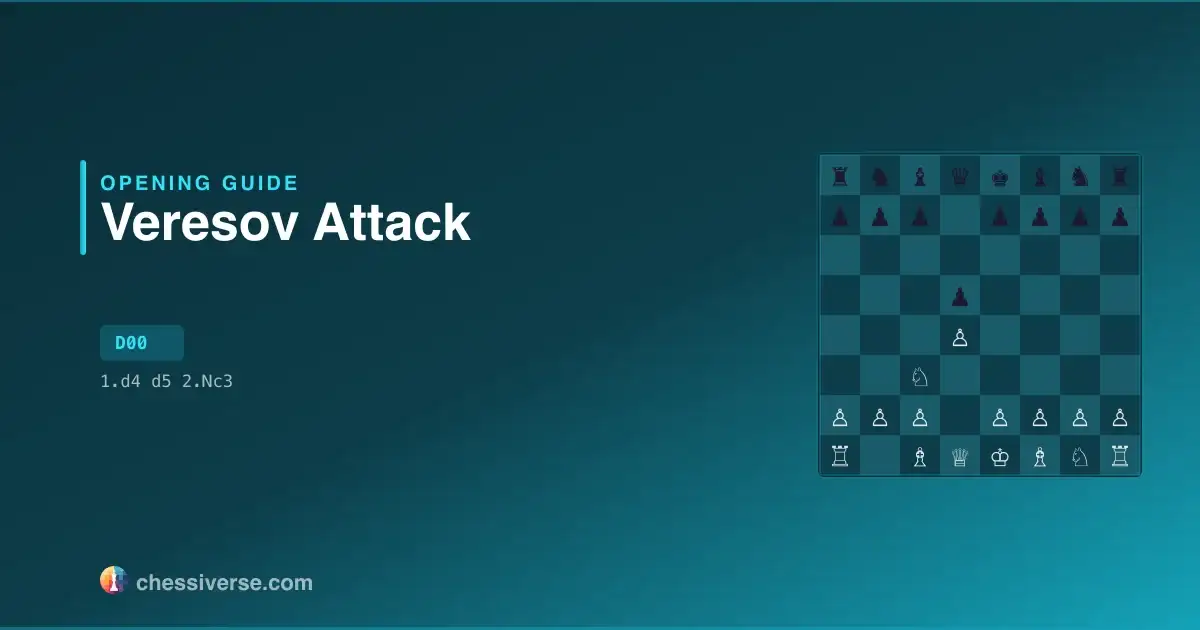


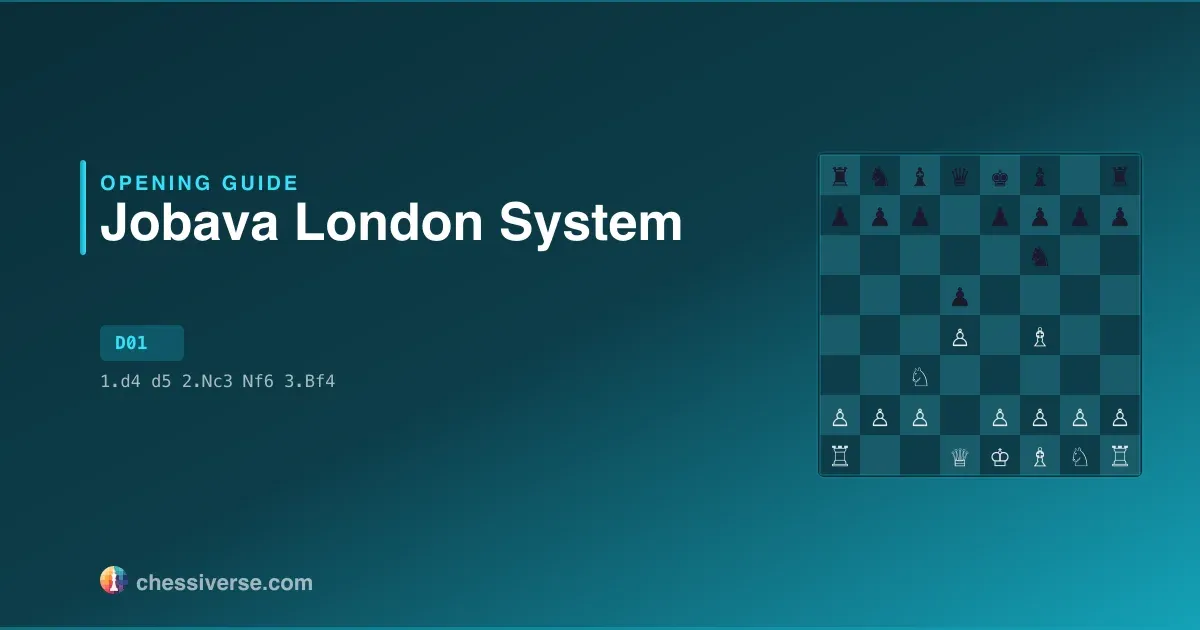
The Jobava London System arises after 1.d4 d5 2.Nc3 Nf6 3.Bf4 and falls under ECO code D01. Lichess and other databases call it the Rapport-Jobava System, and the same position comes from 1.d4 Nf6 2.Nc3 d5 3.Bf4. The bishop goes to f4 as in the London System, but the knight on c3 changes the plan. White can no longer build the c3-d4-e3 pawn triangle; in return the knight can jump to b5, where it joins the f4 bishop in attacking c7. Black has to keep that square covered for the first few moves. Later White often plays e3, sometimes castles queenside and pushes the kingside pawns. With 12.6 million Lichess games across all rating levels, it is a well-established opening choice.
- Bf4 together with Nc3 creates early threats against c7, often with the knight jumping to b5 to join the bishop.
- It is especially common against ...g6 and ...Bg7 set-ups, because the fianchettoed bishop cannot help defend c7.
- Black often challenges the centre at once with ...c5, while ...a6, the Anti-Jobava, takes the b5 square away from the knight.
History and Notable Players
It arises from the Veresov Attack, where 3.Bf4 is the main alternative to the Richter–Veresov Attack (3.Bg5). It is a modern development of the London set-up, named after two grandmasters, Baadur Jobava and Richárd Rapport; the popular name ties Jobava to the London bishop on f4. Among the most active players in ECO D01 games, a code that also covers the Richter-Veresov, are Zvonimir Mestrovic (71 games), Guenther Koksch (56 games) and Robert Graham Wade (54 games) with White, and Wolfgang Uhlmann (8 games), David Bronstein (8 games) and Ticia Gara (6 games) with Black.
A modern development of the London System. The standard London develops the queen's knight to d2, while the Jobava London puts it on c3 next to the bishop on f4, which gives the set-up considerable attacking value.
Named after: Grandmasters Baadur Jobava and Richárd Rapport; databases list it as the Rapport-Jobava System.
Notable players: Baadur Jobava, Richárd Rapport
Statistics
Based on 12.6 million Lichess games across all rating levels:
- White wins: 51.8%
- Black wins: 43.9%
- Draws: 4.3%
White is ahead in every rating bracket, but the margin shrinks as ratings rise: 54% to 42% at 400, and about five to seven points from 1800 up. At 2500 and above White wins 48.2% and Black 42.9%, with 8.9% of games drawn. Faster games favour White too. White wins 54% in bullet, 52% in blitz and 51.4% in rapid. The opening's share of games is lowest around 1800 (0.21%) and highest at 2500 and above (0.68%). It is also growing: its share of Lichess games has risen every year since 2017, from 0.13% to 0.37% in 2025.
Main Lines and Variations
After 1.d4 d5 2.Nc3 Nf6 3.Bf4, the main continuations include:
- 3...c5: the most direct reply, hitting d4 at once. After 4.e3, Black often plays ...cxd4, and exd4 swaps Black's c-pawn for White's e-pawn. 4.e4 is the sharper try.
- 3...a6: the Anti-Jobava. The pawn takes b5 away from the knight before it can get there, and White can carry on with e3 and Nf3, or with an early g4.
- 3...e6: natural development, but 4.Nb5 makes Black deal with c7 at once. 4...Na6 covers it, and so does 4...Bb4+ 5.c3 Ba5.
- 3...Bf5: the bishop comes out before ...e6. White can answer with f3 and g4, gaining kingside space with tempo on the bishop.
- 3...c6 and 3...g6: ...c6 covers b5, so the knight jump is off for now; ...g6 heads for a Grünfeld-style fianchetto, though a bishop on g7 can't help defend c7.
- 3...Nc6: the most common reply below 1400, and the one that walks into the opening's main trick (see below).
Black's choice depends heavily on rating. 3...Nc6 is the most played move at 400, 1000 and 1200 (40.2% of games at 400), 3...e6 leads from 1400 to 1800, and 3...c6 at 2000 and 2200. At 2500 and above, 3...a6 comes first with 25.8%, ahead of 3...c5 with 22.4%.
Common Mistakes to Avoid
- Playing ...Nc6 before c7 is safe: After 3...Nc6 4.Nb5 the c7 pawn is attacked by the knight and the f4 bishop, and only the queen defends it. 4...e6? loses material to 5.Nxc7+, and Black's best, 4...e5 5.Bxe5 Nxe5 6.dxe5, still leaves Black a pawn down. The same idea punishes 3...c5 4.e3 Nc6? 5.Nb5.
- Ignoring 4.Nb5 after 3...e6: c7 needs a defender right away. 4...Be7? 5.Nxc7+ Kf8 6.Nxa8 wins at least the exchange, because 5...Qxc7 6.Bxc7 would lose the queen.
Practice on Chessiverse
The best way to learn the Jobava London System is through practice. On Chessiverse, you can play chess against computer opponents that specialize in this opening. Our AI bots range from beginner to grandmaster level, each with unique playing styles — from aggressive attackers to solid defenders. Choose a bot that matches your rating and work your way up as you master the opening's key ideas.
Performance Across Rating Levels
How well the Jobava London System works depends on what level you're playing at. Among 1200-rated players, it appears in 0.32% of games — 2,164,035 of them on record — with White winning 53% and Black 43.2%. At 1800 the opening surfaces in 0.21% of games; White wins 50.5%, Black 44.9%, draws 4.6%. At the top end (2500+ Elo), popularity is 0.68% with 8.9% draws — a clear sign of how much theory rules the line at master level. White's edge erodes by 4.8pp from 1200 to 2500 Elo, suggesting Black's counterplay is easier to find with experience.
Time Control Patterns
Look at the same opening across time controls and rapid stands out. In bullet, it appears in 0.16% of games (4,356,474); White wins 54%. Blitz shows 0.25% adoption across 9,107,520 games, White scoring 52%. In rapid, the share rises to 0.31% — 3,452,715 games, White 51.4%. White's score swings 2.6pp across formats, so time control isn't just a stylistic choice here — it shifts the actual results.
Move Diversity and Theory Depth
What players actually play after the opening moves depends heavily on rating. At 1200 Elo (2,164,035 games), the top reply is Nc6, played 27.4% of the time. Three other moves each take at least 5% of games, and the top three moves account for 66.4% of games. Entropy: 2.71. By 2500 (93,392 games), a6 takes over as the top reply at 25.8%; five other moves reach 5% and the top three moves account for 67.2% of games. Entropy drops to 2.56.
Historical Trends
Year-over-year data tells you whether this opening is a contemporary fixture or a fading one. Adoption peaked in 2025 at 0.37% (2,766,044 games). 2025 marks the high — the opening is rising, currently at 0.37%.