Sicilian Defense: Lasker-Pelikan Variation

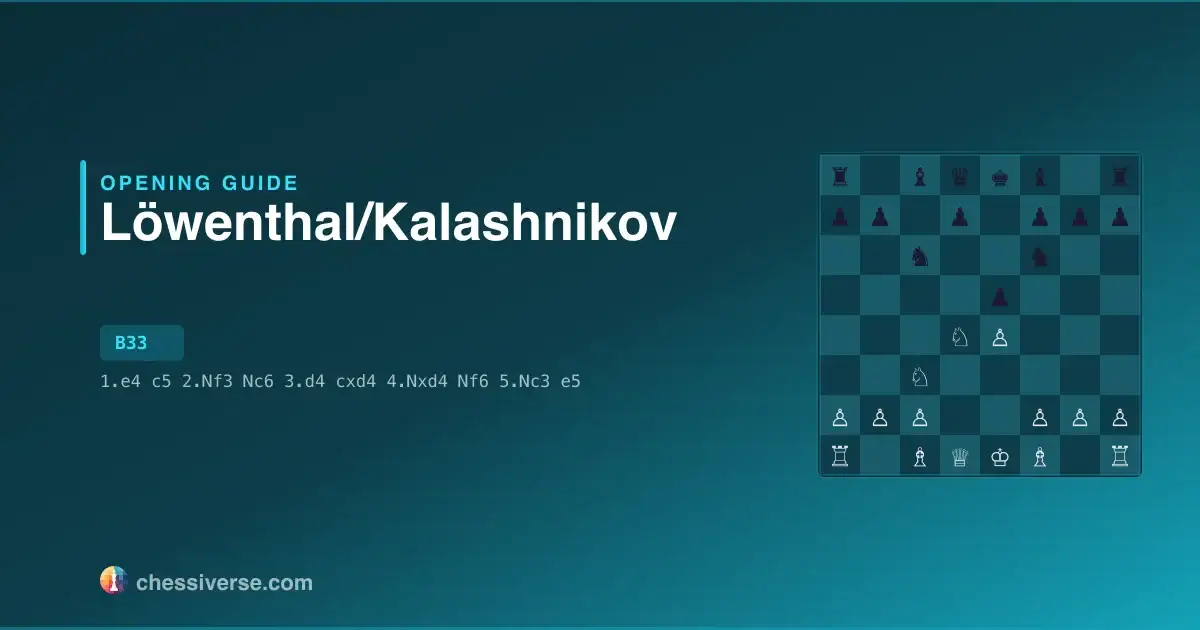
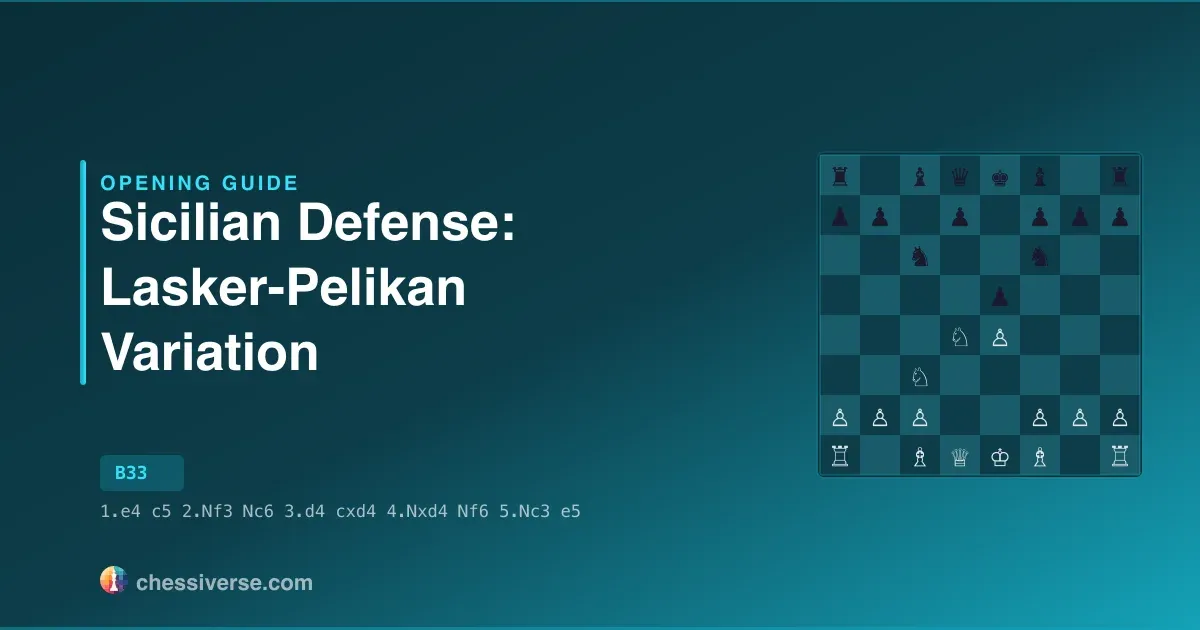
B331.e4 c5 2.Nf3 Nc6 3.d4 cxd4 4.Nxd4 Nf6 5.Nc3 e5
Oct 9, 2026
Play this opening as...
TL;DR

5...e5 chases the d4 knight before Black has played ...d6, so the f8 bishop can still come to b4 or c5. That makes 6.Ndb5, threatening Nd6+, White's critical reply, and 6...d6 7.Bg5 a6 8.Na3 leads into the Sveshnikov. Across 4 million Lichess games White scores 47.5% and Black 46.9%.

Brought to you by

IM John Bartholomew
IM John BartholomewCo-Founder & Chess Educator

International Master and chess educator. Co-founded Chessable and joined Chessiverse as co-founder. Best known for his "Climbing the Rating Ladder" YouTube series and structured opening courses.

Sicilian Defense: Lasker-Pelikan Variation: A Complete Guide
Sicilian Defense: Lasker-Pelikan Variation - Opening Moves
Summary

The Sicilian Defense: Lasker-Pelikan Variation arises after 1.e4 c5 2.Nf3 Nc6 3.d4 cxd4 4.Nxd4 Nf6 5.Nc3 e5 and falls under ECO code B33. Most players call it the Sveshnikov; Lichess keeps the older Lasker-Pelikan name for 5...e5 itself and uses Sveshnikov for the main line that follows. Black kicks the d4 knight straight away and accepts two lasting weaknesses, a backward d-pawn and a hole on d5, in return for a share of the centre and time gained on White's knight. The move order matters. Black's d-pawn is still on d7, so the f8 bishop can come to b4 or c5, and that is why White's critical reply is 6.Ndb5, threatening Nd6+ and making Black spend a move on ...d6. With 4 million Lichess games across all rating levels, it is a well-established opening choice.

  • 5...e5 kicks the d4 knight before ...d6, so the f8 bishop can still reach b4; 6.Ndb5, threatening Nd6+, is White's critical reply.
  • Other knight moves are thought to give Black easy equality: 6.Nf3 and 6.Nb3 meet ...Bb4, and 6.Nf5 runs into ...d5.
  • Black accepts a backward d-pawn and a hole on d5 in return for a central foothold and time gained against White's knight.

History and Notable Players

It arises from the Sicilian Defense: Open (4...Nf6), where 5...e5 is one of Black's main answers to 5.Nc3, next to 5...e6, the Sicilian Defense: Four Knights Variation, and 5...d6, which transposes to the Sicilian Defense: Classical Variation. Emanuel Lasker played 5...e5 once in his world championship match against Carl Schlechter, and Jorge Pelikan used it now and then in the 1950s. It stayed a sideline until Evgeny Sveshnikov and Gennadi Timoshchenko reworked it in the 1970s, and Magnus Carlsen, Vladimir Kramnik and Veselin Topalov have all played it since. Among the most active players in ECO B33 games are Oleg Korneev (89 games), Janis Klovans (74 games) and Thomas Luther (67 games) with White, and Vladimir Kramnik (117 games), Vasilios Kotronias (116 games) and Zdenko Kozul (108 games) with Black.

For decades the line saw only occasional play. Evgeny Sveshnikov and Gennadi Timoshchenko reworked it in the 1970s and established it as a first-rate defence, which is why most players now call it the Sveshnikov.

Named after: Emanuel Lasker, who played 5...e5 once in his world title match with Carl Schlechter, and Jorge Pelikan, who used it in the 1950s.

Notable players: Emanuel Lasker, Evgeny Sveshnikov, Gennadi Timoshchenko, Vladimir Kramnik

Statistics

Based on 4 million Lichess games across all rating levels:

  • White wins: 47.5%
  • Black wins: 46.9%
  • Draws: 5.6%

The overall split is close to even, but it changes at the top. Black is slightly ahead at 1600 and 1800 and level at 2000. From 2200 up, White pulls away: 48.3% to 44.2% at 2200, and 48.8% to 41.1% at 2500 and above, where 10.1% of games are drawn. It is a strong players' line. It appears in 0.01% of games at 1200 and 0.40% at 2200 and above. Of bullet, blitz and rapid, rapid is the only speed where Black scores better, 47.6% to 46.1%. Its share of Lichess games peaked in 2020 at 0.12% and has fallen every year since, to 0.06% in 2025.

Main Lines and Variations

After 1.e4 c5 2.Nf3 Nc6 3.d4 cxd4 4.Nxd4 Nf6 5.Nc3 e5, the main continuations include:

  • 6.Ndb5 d6 7.Bg5 a6 8.Na3: the Sicilian Defense: Sveshnikov Variation. 7.Bg5 targets the f6 knight, Black's main guard of d5, and 7...a6 8.Na3 sends White's knight to the rim. Sveshnikov's 8...b5 then threatens ...b4 against both knights. After 9.Bxf6 gxf6 10.Nd5, Black has doubled f-pawns but the bishop pair and the ...f5 break; 9.Nd5 Be7 10.Bxf6 Bxf6 11.c3 is the quieter main line. The older 8...Be6, the Bird Variation, lets the a3 knight back into play with 9.Nc4.
  • 6.Ndb5 d6 7.Nd5: White trades on d5 first. After 7...Nxd5 8.exd5 the c6 knight has to move, usually to b8 or e7, and White plays on the queenside with an extra pawn there while Black looks for play on the kingside.
  • 6.Nxc6 bxc6: the Exchange Variation. Black's extra centre pawn supports ...d5, and the c6 pawn covers d5, so the hole is gone.
  • 6.Nf3 and 6.Nb3: the Retreat and Schlechter Variations. Both let the f8 bishop out, and 6...Bb4 pins the c3 knight and threatens to win the e4 pawn.
  • 6.Nf5: met by 6...d5!, opening the centre while the f5 knight hangs to the c8 bishop, for example 7.exd5 Bxf5 8.dxc6 bxc6 9.Qf3 Qd7.
  • 6.Nde2: protects the c3 knight against ...Bb4 and ...Bxc3. Black can answer with 6...Bc5 or 6...Bb4.

White's choice depends heavily on rating. 6.Nxc6 is the most played move up to the 1400 bracket (62.6% of games at 400), and 6.Ndb5 takes over from 1600, reaching 85.2% at 2200 and 92.3% at 2500 and above.

Common Mistakes to Avoid

  • Skipping ...d6 after 6.Ndb5: 6...a6? 7.Nd6+ Bxd6 8.Qxd6 costs Black the dark-squared bishop and hands White the bishop pair, and 6...Bc5? 7.Be3 is no better. 6...d6 is close to forced.
  • Retreating with 6.Nf3 or 6.Nb3: White gives up the one move that makes Black pay for 5...e5. After 6...Bb4 the bishop is out before ...d6, which is exactly what Black wanted.
  • Recapturing with the queen after 9.Bxf6: In the Sveshnikov main line, 9...Qxf6? fails to 10.Nd5 Qd8 11.c4 b4 12.Qa4 Bd7 13.Nb5! axb5 14.Qxa8 Qxa8 15.Nc7+ Kd8 16.Nxa8, and White is the exchange up. Take back with 9...gxf6.

Practice on Chessiverse

The best way to learn the Sicilian Defense: Lasker-Pelikan Variation is through practice. On Chessiverse, you can play chess against computer opponents that specialize in this opening. Our AI bots range from beginner to grandmaster level, each with unique playing styles — from aggressive attackers to solid defenders. Choose a bot that matches your rating and work your way up as you master the opening's key ideas.

Performance Across Rating Levels

How well the Sicilian Defense: Lasker-Pelikan Variation works depends on what level you're playing at. Among 1200-rated players, it appears in 0.01% of games — 90,662 of them on record — with White winning 48.7% and Black 47.5%. Move up to 1800 Elo and the share shifts to 0.13%, with White winning 46.8% versus Black's 48.1%. At 2500, 0.40% of games go into this opening; draws sit at 10.1% — the line is well-mapped at this level.

Time Control Patterns

Time control matters here: blitz players reach for this opening more than others. In bullet, it appears in 0.06% of games (1,618,866); White wins 48.3%. Blitz shows 0.09% adoption across 3,384,237 games, White scoring 47.7%. In rapid, the share rises to 0.05% — 599,678 games, White 46.1%. White's score swings 2.2pp across formats, so time control isn't just a stylistic choice here — it shifts the actual results.

Move Diversity and Theory Depth

What players actually play after the opening moves depends heavily on rating. At 1200 Elo (90,662 games), the top reply is Nxc6, played 46.1% of the time. Four other moves each take at least 5% of games, and the top three moves account for 78.4% of games. Entropy: 2.12. By 2500 (55,214 games), Ndb5 takes over as the top reply at 92.3%; no other move reaches 5% and the top three moves account for 96.5% of games. Entropy drops to 0.56. That entropy collapse is the signature of a line where preparation pays off: at the top, players know the best move and play it.

Long-term, the trajectory of this opening is informative. Adoption peaked in 2020 at 0.12% (712,588 games). By 2025 it sits at 0.06%, 49% below the peak and roughly back to its 2013 level, leaving the line flat over the full period.


Quick Facts

Main Line1.e4 c5 2.Nf3 Nc6 3.d4 cxd4 4.Nxd4 Nf6 5.Nc3 e5
FENr1bqkb1r/pp1p1ppp/2n2n2/4p3/3NP3/2N5/PPP2PPP/R1BQKB1R w KQkq - 0 6
DifficultyExpert
Style

Aggressor openings create immediate tension and look for direct attacks. These lines are designed to put pressure on the opponent from the very first moves, often leading to unbalanced positions.

3,983,915games on Lichess
47.5%
5.6%
46.9%
White wins Draws Black wins

Top Players

As White
As Black

Data from Lichess opening explorer (blitz & rapid)

Most Popular At2500
SharpnessVery Sharp

Popularity by Rating

Percentage of all games at each rating bracket that feature this opening.

Data from Lichess opening explorer (blitz & rapid games)

Theory Adherence by Rating

How often players choose the single most popular move at this position. Higher = more predictable play.

White to move after the opening line

Popularity Over Time

Share of all Lichess blitz + rapid games featuring this opening, by year.

Top Moves by Rating

White to move after the opening line

RatingMost Popular2nd3rd
4006.Nxc662.6%6.Nf314.1%6.Nf510.4%
10006.Nxc658.8%6.Nf315.9%6.Nf58.8%
12006.Nxc646.1%6.Nf319.7%6.Ndb512.6%
14006.Nxc634.6%6.Ndb520.4%6.Nf319.3%
16006.Ndb532.5%6.Nxc624.4%6.Nb316.3%
18006.Ndb549.7%6.Nxc616.1%6.Nb315.6%
20006.Ndb568.1%6.Nb311.5%6.Nxc610.4%
22006.Ndb585.2%6.Nxc65.6%6.Nb34.8%
25006.Ndb592.3%6.Nde22.2%6.Nxc62%

Popularity by Time Control

Bullet
0.06%1.6M
Blitz
0.09%3.4M
Rapid
0.05%600K
3% more decisive in bullet
Raw data tables (Lichess blitz + rapid)
Sicilian Defense: Lasker-Pelikan Variation: popularity and win rates by player rating
Rating (Elo)Share %GamesWhite win %Black win %Draw %Sharpness
4000.004,51848.147.84.10.959
10000.0123,23448.547.63.90.961
12000.0190,66248.747.53.90.961
14000.03270,86548.847.24.00.960
16000.06627,29747.747.94.40.956
18000.131,092,15446.848.15.10.949
20000.251,141,77547.146.96.00.940
22000.40678,19648.344.27.50.925
25000.4055,21448.841.110.10.899
Sicilian Defense: Lasker-Pelikan Variation: move-choice theory adherence by rating
Rating (Elo)Top moveTop move %Viable movesTheory %Entropy
4006.Nxc662.6487.01.814
10006.Nxc658.8583.61.862
12006.Nxc646.1578.42.122
14006.Nxc634.6574.42.284
16006.Ndb532.5573.22.299
18006.Ndb549.7581.42.052
20006.Ndb568.1390.01.561
22006.Ndb585.2295.60.912
25006.Ndb592.3196.50.564
Sicilian Defense: Lasker-Pelikan Variation: popularity over time
YearShare %GamesWhite win %Black win %Draw %
20130.061,69046.049.34.7
20140.076,61644.950.15.0
20150.0816,70345.349.65.1
20160.0848,62544.849.75.4
20170.0784,92145.449.35.3
20180.08152,69646.348.55.2
20190.12334,60947.447.55.1
20200.12712,58847.247.05.8
20210.09703,73147.546.85.7
20220.08588,78147.846.65.6
20230.07548,99647.946.55.7
20240.07487,64447.746.65.7
20250.06474,14248.046.35.7
Sicilian Defense: Lasker-Pelikan Variation: popularity by time control
FormatShare %GamesWhite win %Black win %Draw %Sharpness
bullet0.061,618,86648.348.03.70.963
blitz0.093,384,23747.746.85.50.945
rapid0.05599,67846.147.66.30.937
Sicilian Defense: Lasker-Pelikan Variation: top candidate moves by rating bracket
Rating (Elo)1st move1st %2nd move2nd %3rd move3rd %
4006.Nxc662.66.Nf314.16.Nf510.4
10006.Nxc658.86.Nf315.96.Nf58.8
12006.Nxc646.16.Nf319.76.Ndb512.6
14006.Nxc634.66.Ndb520.46.Nf319.3
16006.Ndb532.56.Nxc624.46.Nb316.3
18006.Ndb549.76.Nxc616.16.Nb315.6
20006.Ndb568.16.Nb311.56.Nxc610.4
22006.Ndb585.26.Nxc65.66.Nb34.8
25006.Ndb592.36.Nde22.26.Nxc62.0
Sicilian Defense: Lasker-Pelikan Variation: top practitioners by side
SidePlayerGames
WhiteOleg Korneev89
WhiteJanis Klovans74
WhiteThomas Luther67
BlackVladimir Kramnik117
BlackVasilios Kotronias116
BlackZdenko Kozul108

Play the Sicilian Defense: Lasker-Pelikan Variation

8
7
6
5
4
3
2
a
b
c
d
e
f
g
1h

Start from

Opponent

No account needed — your game saves if you sign up after.

Want the full game experience — enter the game arena! →
Guided Play

Practice this opening with a coach

John follows this exact line and grades every move — green for best, red for blunders — with hints on demand and a blunder guard watching your back.

Training Recommendations

Targeted drills using our bots' unique playstyles to sharpen your skills in this opening.

⚡

Opening Foundations in the Sicilian Defense

beginner

Betty Rookwood, an attacking Savage, relishes deep complications. A friendly entry point for picking up the structure and main ideas.

⚡

Developing Strategy in the Sicilian Defense

intermediate

Tina Turner plays patiently — a defensive Guardian who cuts down the position. A solid step up when the textbook lines stop being enough.

⚡

Proving Your Preparation in the Sicilian Defense

skilled

Wu Cheng, a defensive Guardian, simplifies the position to neutralize the initiative, while all-round Mediator NM Ben Johnson adapts to whatever the game becomes. Use this matchup to stress-test the lines you have actually studied.

⚡

Elite Competition in the Sicilian Defense

advanced

Soris Bassky is a defensive Observer who is hard to crack in complicated positions, while Gotta Promotion, an attacking Savage, relishes deep complications. Practice at the advanced level to face master-strength resistance.

Frequently Asked Questions

Sicilian Defense: Lasker-Pelikan Variation

What is this opening?

This opening begins with 1.e4 c5 2.Nf3 Nc6 3.d4 cxd4 4.Nxd4 Nf6 5.Nc3 e5 and is classified under ECO code B33. Most players know it as the Sveshnikov, the name of its main line after 6.Ndb5 d6 7.Bg5 a6 8.Na3.

Is this opening good for beginners?

This opening can be played at any level. Beginners should focus on understanding the key strategic ideas rather than memorizing long theoretical lines. Our AI bots at various rating levels provide a great way to practice the opening concepts.

What are the win rates for this opening?

Across 4 million Lichess games, White wins 47.5% of the time, Black wins 46.9%, and 5.6% are drawn. Among the most active players in ECO B33 games are Oleg Korneev and Janis Klovans with White, and Vladimir Kramnik and Vasilios Kotronias with Black.

How can I practice this opening?

On Chessiverse, you can practice this opening against AI bots specifically designed to play this opening. Our bots range from beginner (around 1354 rating) to advanced (2925+ rating), so you can find the right challenge for your level.

Sources

Brought to you by

IM John Bartholomew
IM John BartholomewCo-Founder & Chess Educator

International Master and chess educator. Co-founded Chessable and joined Chessiverse as co-founder. Best known for his "Climbing the Rating Ladder" YouTube series and structured opening courses.

Practice This Opening on Chessiverse

Play against 1000+ AI bots with unique personalities and opening repertoires. From beginner-friendly to grandmaster-level opponents, find the perfect sparring partner for any opening.

Play Now

Not sure which opening fits you? Take the free chess personality test — your style determines which openings will work with you.

Back to Articles